

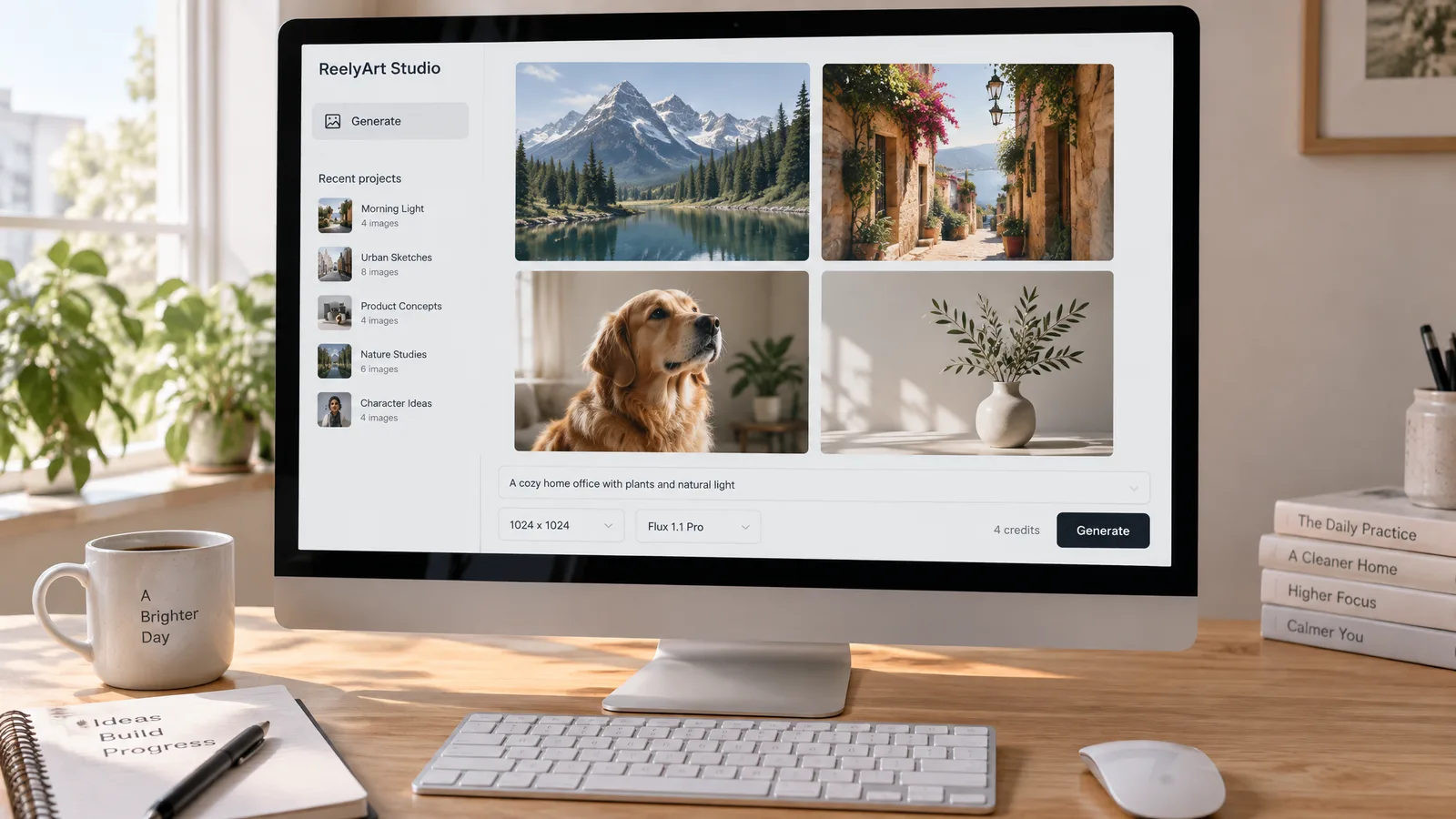
As of September 2026, ReelyArt Studio runs ten AI image models from Google, OpenAI, ByteDance and xAI inside one composer: Nano Banana 2 and Nano Banana Pro, GPT Image 2.5 Flare and Sunburst, GPT Image 2 and GPT Image 1.5, Seedream 5 Pro, Seedream 5 Lite and Seedream 4.5, and Grok Image 2. You write one prompt, attach up to eight reference images, and pick the model from a menu. Eight of the ten run on the free plan at their opening tier, and every generation is priced in credits, from 2 per image.
This guide is the long version of the models index: what each model is genuinely good at, what it costs at each resolution, which tiers are free, and how to decide which one to use for the job in front of you. Every image below was generated in Studio, most of them from the same prompt on every model, so the comparisons are honest.

Each of these models is available elsewhere, usually behind its own subscription, API key or app. What Studio changes is not the models but the workflow around them.
A prompt, a set of reference images, an aspect ratio and a quality tier are one saved setup. Switching the model is a dropdown, not a new tab, so a draft made on a fast model can be re-run on a flagship without re-uploading anything. Every finished image has an Edit action that takes a plain-language change ("make the jacket navy", "remove the text on the left") and produces a revised copy next to the original, at the same price as a single generation. And the template library is organised by the model each template was written for, about a hundred curated templates at the time of writing, seventy of them on Nano Banana 2 and thirty on GPT Image 2, so a template built around one model's way of handling references opens with that model loaded.
The practical result is that the question "which model should I use?" stops being a commitment. You try two, keep the better one, and move on.

Google's everyday image model, Gemini 3.1 Flash Image, and the house model in Studio. Its defining strength is character consistency: a face, a mascot or a profile picture survives a transformation recognisably, which is why most of the curated templates are written for it. It takes up to eight reference images and follows counted, specific instructions well.
Resolutions and credits: 1K for 2, 2K for 3, 4K for 5. Both everyday tiers, 1K and 2K, are on the free plan. Model page · Open in Studio

Gemini 3 Pro Image, the flagship. It renders genuine 4K, keeps small in-image text legible, and holds a crowded scene together where faster models start to smear. It is the most expensive model in the catalog to run, so it belongs at the end of a process, not the start: draft on Nano Banana 2, then switch to Pro for the final with the same references and prompt.
Resolutions and credits: 1K for 4, 2K for 5, 4K for 8. Paid plans only. Model page · Open in Studio

OpenAI's fast everyday model, and the first in the catalog with a true 4K at every aspect ratio, the square included. It is quick enough to keep changing your mind, which makes it the natural model for concept boards, thumbnails, product renders and character ideation, anything where you want four directions in one pass before committing to one.
Resolutions and credits: 1K for 2, 2K for 3, 4K for 4. The 1K tier is on the free plan. Model page · Open in Studio

OpenAI's most capable image model, for the change that has to happen exactly where you asked and nowhere else. Same sizes and same prices as Flare; it takes longer and holds more. Use it for precise reference-image edits, typographic layouts with exact strings, interface mockups with dense text, and character turnarounds where the design must not drift between views.
Resolutions and credits: 1K for 2, 2K for 3, 4K for 4. The 1K tier is on the free plan. Model page · Open in Studio

The previous OpenAI generation, kept because it follows layout instructions unusually well and keeps the subject of an uploaded photo intact. It is the model for product mockups, poster compositions and anything that has to line up. On the free plan it accepts four reference images; paid plans get the full eight.
Resolutions and credits: 1K for 2, 2K for 3. The 1K tier is on the free plan. Model page · Open in Studio

The budget OpenAI model, and the only one whose every tier is on the free plan. It renders the classic photographic formats, 1:1, 3:2 and 2:3, with the familiar GPT editing behaviour, at the lowest price on the site. A good place to draft when the brief is still moving.
Resolutions and credits: 1K for 2. Entirely on the free plan. Model page · Open in Studio

ByteDance's flagship, tuned for how a photograph actually looks: skin, fabric, glass and light. When the goal is "this could be a photo", start here. Portraits, cinematic lighting and night moods are its territory.
Resolutions and credits: 1K for 2, 2K for 4. Paid plans only. Model page · Open in Studio

The Seedream look at draft prices, with one distinction worth knowing: its ladder starts at 2K, where most models' free tier stops at 1K. That puts it, with Nano Banana 2 and Seedream 4.5, at the highest free resolution in Studio, and makes it a strong choice for scenery, interiors and anything that benefits from detail at a low cost.
Resolutions and credits: 2K for 2, 3K for 3. The 2K tier is on the free plan. Model page · Open in Studio

The previous Seedream generation, kept in the catalog for one reason: it renders true 4K at half the flagship's price. Wallpapers, large-format landscapes and epic scenes are where it earns its place.
Resolutions and credits: 2K for 2, 4K for 4. The 2K tier is on the free plan. Model page · Open in Studio

xAI's image model, the one behind Grok Imagine, without the X Premium subscription. It is the odd one out in the catalog: it takes at most one reference image and composes its own frame rather than accepting an aspect ratio. In return it answers a single sentence with a bold, confident, stylised image. Use it for attitude, not for precision.
Resolutions and credits: 1K for 2, 2K for 3. The 1K tier is on the free plan. Model page · Open in Studio
The fairest way to see the differences is to hold everything constant except the model. Below, one uploaded character was reimagined as a collectible vinyl toy in a diorama, with the same prompt and the same reference, on Nano Banana 2, GPT Image 2 and Seedream 5 Pro.


Nano Banana 2 keeps the most of the original character. GPT Image 2 treats the diorama as a layout problem and arranges it most deliberately. Seedream 5 Pro lights it like a product photograph. None of them is wrong; they are answering different questions, and in Studio you can ask all three for the price of three images.
| The job | Start with | Then, if needed |
|---|---|---|
| Keep a mascot or PFP recognisable through a new scene | Nano Banana 2 | Nano Banana Pro for the 4K final |
| A poster with text that has to read | Nano Banana Pro | GPT Image 2.5 Sunburst for exact strings |
| Four directions from one brief, fast | GPT Image 2.5 Flare | Sunburst to finish the chosen one |
| Change one thing in a photo and nothing else | GPT Image 2.5 Sunburst | — |
| Product mockups, packaging, flat-lays | GPT Image 2 | Sunburst for dense labels |
| Drafts in classic photo formats, for free | GPT Image 1.5 | any flagship |
| "This could be a photo" | Seedream 5 Pro | — |
| Detailed scenery on a budget | Seedream 5 Lite | Seedream 4.5 for 4K |
| A 4K wallpaper without the flagship price | Seedream 4.5 | — |
| One bold, stylised image from one sentence | Grok Image 2 | — |
Studio is the image step. The same account carries the tools that turn an image into the formats people actually post. The AI GIF Maker animates a still into a looping GIF and returns the MP4 from the same run, no conversion step. The AI Sticker Maker cuts a character into transparent PNG stickers sized for Telegram, Discord and WhatsApp. Header Studio renders X headers and Discord banners at each platform's exact pixel size. Because every tool reads the same uploaded reference, the character in your GIF is the character in your stickers and your banner.
Every generation costs credits, and the price depends only on the model and the resolution: from 2 credits an image up to 8 for Nano Banana Pro at 4K. New accounts start with 10 free credits and can run eight of the ten models at their opening tier, Nano Banana 2 up to 2K, Seedream 5 Lite and Seedream 4.5 at 2K, and the OpenAI models and Grok at 1K. Nano Banana Pro, Seedream 5 Pro and the higher tiers of the rest are on paid plans, which start at $9 a month for 100 credits. One-time credit packs never expire. The full ladder is on the pricing page.
Do I need an API key or a subscription to each provider? No. Studio runs the models server-side. One ReelyArt account covers all ten, and the free plan needs no card.
Can I use the same reference images on every model? Yes, up to eight per generation on every model except Grok Image 2, which takes one. On the free plan the OpenAI models accept four.
Is the resolution real? Yes. Each model lists only the tiers it genuinely renders, so a 4K on Nano Banana Pro, GPT Image 2.5 or Seedream 4.5 is a 4K file, not an upscaled 1K.
Can I edit a result without regenerating? Every finished image has an Edit action that takes a plain-language change and produces a revised copy beside the original, at the price of one generation at the selected quality.
Which model should I try first? Nano Banana 2. It is free at 1K and 2K, it keeps characters consistent, and most templates are built for it. When it falls short, the table above says where to go next.
Open Studio, pick a model, and run the same prompt twice.